The Farm of the Future: Urban Hydroponic Production

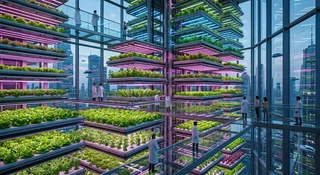
The Rise of Urban Farming
More than half of the world’s population now lives in cities, and this share is projected to reach 68% by 2050 (UN DESA, World Urbanization Prospects: The 2018 Revision). Meanwhile, traditional farmland is shrinking: 10 million hectares of agricultural land are lost annually due to urbanization, erosion, and climate change. These two trends raise a critical question: How will we feed the growing urban population?
The answer lies in bringing the farm to the city. Hydroponic urban agriculture shortens the supply chain by bringing food production to the closest point to consumers, reducing carbon footprint and increasing food security.
Space Efficiency: 1m² = 10m²
The most striking advantage of hydroponic systems is space efficiency. Compared to traditional farming:
Lettuce Example
- Open field: 1m² → 4-6 heads of lettuce/harvest (3-4 harvests/year) = 12-24 heads/year
- Hydroponics (NFT): 1m² → 16 heads/harvest (12 harvests/year) = 192 heads/year
- Efficiency Multiplier: 8-16x more production
Why So Efficient?
- Vertical Layering: 2-6 layers of hydroponic systems can be installed on the same footprint
- Faster Growth: Plants grow 25-50% faster in controlled environments
- Continuous Production: No seasonal gaps, 365-day production
- Zero Loss: No losses from pests, diseases, drought
- Optimal Density: Each plant positioned at calculated spacing
Sustainability Benefits of Urban Production
1. Carbon Footprint Reduction
In traditional supply chains, leafy vegetables travel an average of 2,500 km before reaching consumers. Hydroponic urban farming:
- Transportation Emissions: 95% reduction (local production, 5-50 km distribution)
- Cold Chain Duration: 2-24 hours instead of 7-10 days
- Packaging Material: 40% less plastic (retail delivery vs. wholesale transport)
Real Data: A 1,000 m² hydroponic facility in Istanbul avoids 100 tons of CO₂ emissions annually by producing ~40 tons of leafy vegetables (transportation + cold chain basis).
2. Water Efficiency
Water circulates in a closed loop in hydroponic systems:
- Open farming: 250 liters of water per 1 kg of lettuce
- Hydroponics: 20 liters of water per 1 kg of lettuce
- Savings: 95% less water consumption
In water-stressed metropolises like Istanbul, this is a critical advantage. A 1,000 m² facility saves approximately 690,000 liters (690 m³) of water annually — equivalent to the annual drinking water needs of about 11-12 people.
3. Zero Pesticides, Zero Chemicals
Since closed-environment production is isolated from pests and diseases:
- Zero pesticide requirement
- No herbicides needed (no soil)
- Minimal fungicide need (humidity control)
Result: 100% organic-equivalent products without certification costs.
4. Land Use and Biodiversity
1 hectare (10,000 m²) of hydroponics can produce the equivalent of 10 hectares of open fields. This allows 9 hectares to be:
- Returned to natural habitat
- Converted to forested area
- Preserved as carbon sinks
Converting urban unused spaces (rooftops, empty buildings, parking lots) to agriculture increases food production without touching natural ecosystems.
Food Security and Crisis Resilience
Urban hydroponic production makes food systems resilient to external shocks:
Pandemic and Supply Chain Disruptions
The COVID-19 crisis showed the fragility of the global food supply chain:
- International shipping delays
- Border closures
- Export bans in supplier countries
Hydroponic Advantage: Local production eliminates external dependencies. Hydroponic facilities in Istanbul continued production without interruption during the pandemic.
Climate Change and Extreme Weather Events
The 2023 Kahramanmaraş earthquake, Western Mediterranean fires, and Black Sea floods seriously damaged Turkey’s food production. Hydroponic urban farming:
- Climate Independent: External weather conditions don’t affect production
- Rapid Post-Disaster Setup: Mobile container systems can be operational in 7 days
- Energy Redundancy: Solar+generator combination protects against power outages
Food Price Volatility
In traditional farming, factors like drought/flood/frost can increase prices by 200-300%. Hydroponic production:
- Fixed-cost production (energy, nutrients, labor)
- Price predictability (for consumers)
- Long-term supply contracts (for B2B customers)
Integration with Urban Planning
1. Rooftop Farming
Istanbul has approximately 500 km² of rooftop area (flat roofs). If just 1% of this area were converted to hydroponic production:
- 5 km² = 5 million m² production area
- Annual 25,000 tons of fresh produce (lettuce equivalent)
- 20% of leafy vegetable needs for 4 million people
Scenario Example: A district municipality could install 450 m² hydroponic systems on 3 school rooftops, producing approximately 7 tons annually and providing fresh vegetables to 1,200 students.
2. Vertical Farms
Conversion of old factory buildings and unused warehouses:
- Scenario Example: A 2,500 m² old textile factory → 6-story vertical hydroponic farm
- Annual production of 80 tons
- Employment for 25 people
- Local supply to 50 restaurants in the region
3. Mixed-Use Projects
Hydroponic integration in new constructions:
- Scenario Example: An urban transformation project with 2,000 m² common area hydroponic systems across 12 blocks
- 30% discounted fresh produce for residents
- 15% reduction in common area fees (energy sharing)
- +15 points contribution to LEED Gold certification
Economic Models and Profitability
Investment-Return Analysis
1,000 m² urban hydroponic facility (lettuce production):
- CAPEX: 18 million TL (container+system+installation)
- OPEX: 4.2 million TL/year (energy, nutrients, labor, rent)
- Revenue: 9.2 million TL/year (40 tons × 230 TL/kg average selling price)
- Net Profit: 5.0 million TL/year
- ROI: 3.6 years
Revenue Diversification
Beyond just product sales:
- Agro-Tourism: Facility tours, educational workshops (school groups, corporate events)
- B2B Contracts: Annual supply agreements with restaurants, hotels, supermarkets
- Franchise/Consulting: Model transfer to other cities
- Carbon Credits: CO₂ reduction certification (voluntary carbon market)
Technological Developments
1. Artificial Intelligence and Automation
Next-generation hydroponic facilities:
- Image Processing: Early detection of disease and deficiency (95% accuracy)
- Predictive Maintenance: Equipment failure risk prediction (preventive intervention)
- Optimization Algorithms: 18% reduction in energy consumption, 12% increase in yield
Technoponic KOBUS System: Turkey’s first domestically-developed AI-assisted hydroponic management platform. Autonomous control for 15+ different products.
2. Renewable Energy Integration
The biggest cost of urban facilities is energy (40-50% of OPEX). Solutions:
- Rooftop Solar Panels: 30-60% of energy needs met
- Waste Heat Recovery: Heat transfer from neighboring buildings’ air conditioning
- Wind Turbines: Micro wind systems in high-rise buildings
Real Data: An 1,200 m² rooftop facility in Ankara reduced annual energy costs by 55% with 80 kWp solar.
3. Mobile and Modular Systems
Container-type hydroponic units:
- 40ft Container: 28 m² production area, 3.5 tons of lettuce annually
- Installation Time: 3 days (plug-and-play)
- Portability: Can be deployed to disaster areas, temporary settlements
Social Impact
1. Job Creation
1,000 m² facility = 5-8 full-time employment (agricultural technicians, harvesting team, quality control, logistics, sales)
Women’s Employment: 60% of hydroponic facility workers are women (less physically demanding, easy access to city center).
2. Education and Awareness
Urban facilities make food production visible:
- School Tours: Students learn where food comes from
- Community Gardens: Neighborhood residents grow their own lettuce/basil
- STEM Education: Integration of biology, chemistry, engineering
3. Eliminating Food Deserts
In low-income neighborhoods, access to fresh produce is limited (markets expensive/far). Hydroponic mobile units:
- Setup within 500m of neighborhood
- 20% lower pricing (no transportation)
- Daily fresh produce (2-hour harvest-delivery time)
Urban Farming in the Next 10 Years
2025-2030 Forecasts
- Global Market Growth: The vertical farming market was valued at ~$5.6-9.6 billion USD in 2024 and is projected to reach $24-33 billion USD by 2030 (~20-25% CAGR). Sources: Grand View Research 2025, Allied Market Research 2022, MarketsandMarkets 2024, Fortune Business Insights 2023.
- Turkey — Current Baseline: According to Turkey’s Ministry of Agriculture and Forestry, soilless agriculture is practiced in 52 provinces, 692 facilities, 1,483 production units across ~15,000 decares (~1,500 hectares), mostly in rural greenhouses (Turkish Agriculture Journal). Large-scale urban closed-environment facilities remain in single-to-double digits — e.g., the Istanbul Kağıthane Closed Vertical Farming Center (2022). Our sector forecast: triple-digit urban large-scale facility count by 2030.
- Policy Support: Under IPARD III (2021–2027), modern greenhouses and agricultural investments are eligible for 40-65% grants; the KKYDP 2023–2024 program provides up to 50% grants for agricultural economic investments. At the municipal level, the Turkey-EU Town Twinning II “Green Future” program funds climate and food projects.
- Consumer Preference: As of 2023, 35% of Turkish consumers report buying more local products and 87% expect to maintain this preference (Marketing Türkiye, Fast-Moving Consumer Goods report, 2023). Specific consumer data on “local hydroponic” labeling is not yet published and will be updated when sector data becomes available.
Technology Trends
- Gene Editing: Plant varieties optimized for hydroponic environments (more compact, faster growing)
- Blockchain Traceability: Seed-to-table complete records via QR code
- Smart Packaging: Sensor-enabled packaging showing product freshness
Regulatory Developments
- Organic Certification: EU in process of recognizing hydroponic products as “organic” (expected 2026)
- Carbon Accounting: Standards for urban farming carbon credit earnings (ISO 14067)
- Building Codes: Inclusion of hydroponics in “%X green space” requirement for new commercial/residential buildings
Conclusion: The Farm of the Future Is Here
Urban hydroponic production is not a trend, it’s a necessity. Growing population, shrinking land, climate crisis, and supply chain fragility require us to rethink our food systems.
Hydroponic technology turns our cities into food producers:
- Environmental sustainability (water, energy, land savings)
- Economic opportunity (investment, employment, export potential)
- Social benefit (food security, education, community bonds)
Imagine a farm: 10,000 m², soil, tractor, dependent on sunshine. Now think of another farm: In the city center, on a building rooftop, 1,000 m², 10x more efficient, 365-day production, controlled, clean, safe.
Which is the farm of the future? The answer is clear. Now it’s time to build this future.
About Us: Technoponic is Turkey’s leading hydroponic farming technology company. We have completed 50+ successful projects with our KOBUS AI platform. For more information about urban farming: info@technoponic.com
