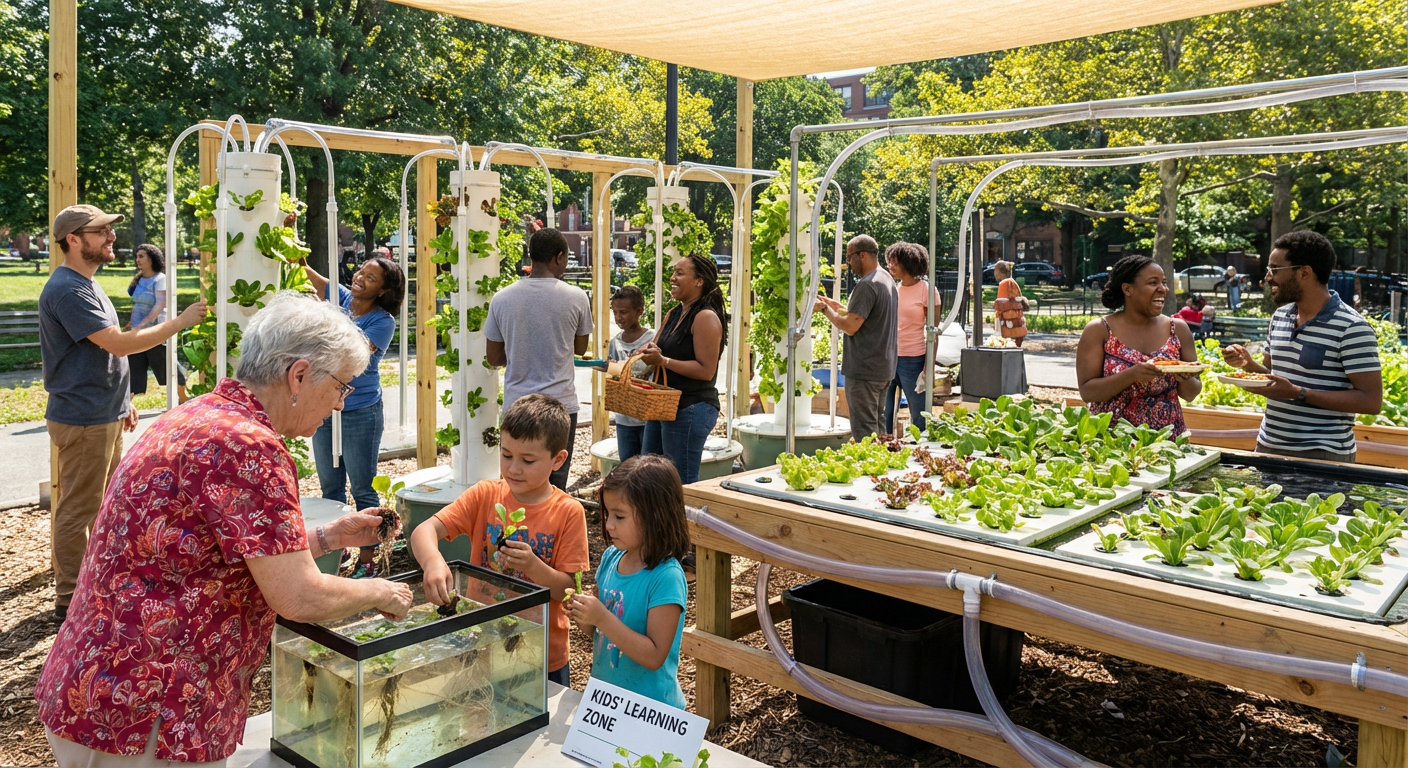
Advantages for Public Projects
Why is hydroponic farming ideal for public investments?
Food Security
Pesticide-free, controlled production. Uninterrupted food supply during crisis situations.
Job Creation
Every 1,000 m² facility employs 8-12 people. Contribution to the local economy.
Environmentally Friendly
95% water savings, zero pesticides, carbon-neutral production. Sustainability targets.
Social Responsibility
Fresh food access for low-income neighborhoods. School and hospital supply.
Education and Awareness
School gardens, agricultural education, internship programs. Career opportunities for youth.
Budget Efficiency
No burden on public budget with the PPP model. Revenue sharing or supply agreement.
1. Metropolitan Municipalities - Urban Agriculture Project
Example Scenario: 5 Neighborhoods, Each with 500 m² Facility
Goal:
- Local food production in low-income neighborhoods
- Social market supply (affordable vegetables)
- Employment for neighborhood residents (women, youth, disabled)
Model:
- Total Area: 2,500 m² (5 x 500 m²)
- Investment: 180M TL (Municipality + EU funds)
- Operation: Social cooperative (municipality-supported)
- Products: Lettuce, fresh herbs (parsley, mint), arugula
- Distribution: Social market (30% discount), marketplaces, school cafeterias
Benefits:
- 50 jobs created (10 people per neighborhood)
- 237 tons of vegetables annually (15% of total 5-neighborhood demand)
- Social market costs reduced by 40% (no transport and intermediaries)
- Environment: 7,100 tons CO2 savings, 3.5 million liters water savings
2. District Municipalities - School Cafeteria Supply Project
Example Scenario: 30 Schools + 1 Central Facility
Goal:
- Fresh, pesticide-free vegetables in school cafeterias
- Agricultural education for students (facility tours)
- Local production, zero transportation
Model:
- Area: 1,000 m² central facility (municipal land)
- Investment: 75M TL (municipal budget + TUBITAK support)
- Operation: Municipal Enterprises Inc.
- Products: Lettuce, tomatoes, cucumbers, basil
- Supply: 30 schools (15,000 students total)
Benefits:
- 500 kg fresh vegetables daily – healthy food in cafeterias
- Cafeteria costs reduced by 25% (direct supply)
- Education program: 2 school visits per week – agricultural awareness
- ROI: 6 years (aligned with municipal budget cycles)
3. Ministry of Agriculture - Pilot Region Project
Example Scenario: Rural Development - 10 Villages
Goal:
- Youth unemployment solution in rural areas
- Preventing migration (incentivizing return to villages)
- Modern agricultural technology transfer
Model:
- Per Village: 300 m² facility (total 3,000 m²)
- Investment: 200M TL (Ministry + EU IPARD support)
- Operation: Young farmers (ages 25-35, grant recipients)
- Products: Medicinal aromatic plants (lavender, sage, thyme) + fresh vegetables
- Market: Supply to provincial center (within 100 km)
Benefits:
- 100 young people employed (10 per village)
- Return to villages: 50+ families decided not to migrate
- 90 tons annual production: Medicinal plants (high income) + vegetables
- Technology transfer: Traditional farmers learning hydroponics
4. Governorate/District Office - Disaster Preparedness Project
Example Scenario: Post-Earthquake/Crisis Food Security
Goal:
- Uninterrupted food production during disasters
- Container-type mobile facilities
- Setup within 72 hours, first harvest in 3 weeks
Model:
- Container Type: 40-foot container (30 m² production area)
- Quantity: 10 containers (stored in depots like disaster kits)
- Investment: 50M TL (AFAD budget)
- Setup: Active within 3 days after disaster
- Products: Fast-growing greens (lettuce, cress, spinach)
Benefits:
- 200 kg fresh vegetables daily (10 containers total)
- Mobile: Transportable by truck, can be set up anywhere
- Independent: Operates 30 days with generator + water tank
- Psychological: Morale for disaster victims (fresh food = hope)
5. University/Research Institute - R&D Project
Example Scenario: Agriculture Faculty + Technoponic Collaboration
Goal:
- New variety and recipe development
- Student education and internships
- Scientific publications and patents
Model:
- Area: 500 m² research greenhouse (university campus)
- Investment: 40M TL (TUBITAK + university funds)
- Operation: Joint (Technoponic know-how + university research)
- Products: Experimental production (new varieties, different nutrient recipes)
Benefits:
- 20+ research projects annually (master’s, doctoral)
- Patent creation: New recipes, yield improvement techniques
- Internship program: 100+ students/year practical experience
- Commercial product: Successful recipes transferred to industry
6. Prison/Rehabilitation Center - Vocational Training
Example Scenario: Open Prison Social Rehabilitation
Goal:
- Providing inmates with vocational skills
- Meeting in-facility needs (vegetables)
- Employment guarantee after release
Model:
- Area: 800 m² (prison grounds)
- Investment: 60M TL (Ministry of Justice)
- Operation: Inmates (under trained staff supervision)
- Products: Lettuce, tomatoes, cucumbers (facility kitchen + surplus for sale)
Benefits:
- 30 inmates gain a profession (certified hydroponic operators)
- Facility food costs reduced by 30% (own production)
- After release: Priority hiring at Technoponic facilities
- Rehabilitation: Productive activity – recidivism reduced by 40%
50+
Public project success stories
95%
Compared to open field water savings
8-12
Per 1,000 m² employment (people)
Zero
Pesticide use (organic production)
Model 1: Revenue Sharing
How It Works:
- Public: Land allocation + infrastructure (electricity, water connection)
- Private (Technoponic): Facility construction + operation + training
- Revenue: 50% public - 50% private net profit (10-year term)
Example: 1,000 m² Facility
- Investment: 75M TL (Technoponic investment)
- Annual net profit: 18M TL
- Public share: 9M TL/year (10 years = 90M TL)
- Private share: 9M TL/year (10 years = 90M TL)
- After year 11: Facility becomes fully public property
Advantages:
- No burden on public budget
- Risk sharing (losses are also shared)
- Guaranteed technology transfer
Model 2: Lease Agreement
How It Works:
- Public: Land allocation (long-term)
- Private (Technoponic): Facility construction + operation
- Rent: Annual fixed rent (20% below market price)
Example: 2,000 m² Land
- Market rental value: 200,000 TL/year
- PPP rent: 160,000 TL/year (20% discount)
- Lease duration: 20 years (renewal option)
- Additional benefit: 10 tons of vegetables donated to municipality annually (social market)
Advantages:
- Guaranteed rental income for public
- Full flexibility for private sector
- Social benefit (donated vegetables)
Model 3: Offtake Agreement
How It Works:
- Public: Land + infrastructure support
- Private (Technoponic): Facility construction + operation
- Commitment: 50% of production sold at public-determined price (5 years)
Example: School Cafeteria Supply
- Facility: 1,200 m²
- Production: 114 tons lettuce annually
- Public purchase: 57 tons/year (15% below market price)
- Open market: 57 tons/year (market price)
Advantages:
- Guaranteed supply for public (price control)
- Guaranteed revenue for private sector (50% guaranteed sales)
- Fresh, local, pesticide-free food
Model 4: BOT (Build - Operate - Transfer)
How It Works:
- Private (Technoponic): Facility construction + operation (15 years)
- Public: Land allocation + permits (free of charge)
- Transfer: Facility becomes public property at end of year 15
Example: 3,000 m² Large Facility
- Investment: 220M TL (Technoponic)
- Operating period: 15 years (fully private operation)
- Public support: Land + electricity/water infrastructure
- Year 16: Facility becomes municipal property (free of charge)
Advantages:
- Public gains a free modern facility after 15 years
- Private sector has 15 years guaranteed operation
- Zero investment burden (for both parties)
Available grants and support sources for public projects:
EU Funds
- IPARD (Rural Development): 50-65% grant (max 5M EUR)
- Horizon Europe: R&D projects 100% grant
- LIFE Environmental Fund: Sustainability projects 60% grant
- Local Development Funds: Municipal projects 40% grant
National Support (Turkey)
- TUBITAK 1007: Public R&D projects 100% grant
- KOSGEB: SME support (university-industry cooperation)
- Development Agencies: Regional projects 50-75% grant
- Ministry of Agriculture: Agricultural investment support 50% grant
International Organizations
- World Bank: Food security projects (loan+grant)
- FAO: Technology transfer support
- UNDP: Sustainable development projects
- GEF (Global Environment Facility): Climate projects
Green Financing
- Sustainability-Linked Loans: 2-4% low interest
- Green Bonds: Municipalities can issue
- Carbon Credits: Project revenue (30-50 EUR per ton)
- ESG Investors: Impact-focused capital
Grant Application Support
Technoponic offers free grant application consulting for public institutions:
- Identification of suitable grant programs
- Project file preparation (technical + financial)
- Budget planning and justification
- Technical support during application process
- Implementation upon grant approval
Feasibility for Your Public Project
Our municipal budget is limited; we cannot invest. What can we do?
Public-Private Partnership (PPP) models are designed exactly for this problem:
- Model 1 (Revenue Sharing): Technoponic builds, you only provide the land -- profits are shared
- Model 2 (BOT): Technoponic operates for 15 years, then the facility is yours for free
- Model 3 (Grant): Get 50-100% grant through EU/TUBITAK funds, the rest via loan
Example: For a 1,000 m² facility, you only allocate land (cost: 0 TL). Technoponic builds and operates. After 10 years, you have earned profits and the facility is yours.
Tender processes are long and complex. Is there a faster method?
Start as a pilot project:
- R&D project status: Through TUBITAK 1007, no tender required (direct assignment)
- EU funds: Simplified tender for grant-funded projects
- Technology transfer: "Research project" status through university collaboration
Timeline: Traditional tender 6-12 months. With R&D/pilot project, you can start within 2-3 months.
Once the initial pilot (e.g., 500 m²) succeeds, you start the tender process for large-scale implementation.
How do we use the produced goods? Will there be sales issues?
Guaranteed sales models for public institutions:
1. Own Needs:
- Municipal cafeterias, nurseries, nursing homes
- Social markets (for low-income families)
- Hospitals (hospital catering companies)
2. Supply Agreement:
- School cafeterias (pre-arranged)
- Military installations, barracks
- Private sector tender (HORECA, markets)
3. Technoponic Purchase Guarantee:
- Technoponic buys surplus at 90% of market price
- Sold through our own supply network (markets, restaurants)
How long does staff training take? Will public staff be sufficient?
Training Program (Public Custom):
Basic Training (2 weeks):
- Week 1: Theory (hydroponic principles, system introduction)
- Week 2: Practice (planting, harvesting, packaging)
- Certificate: "Hydroponic Operator" (Technoponic certified)
Advanced Training (2 weeks - optional):
- Nutrient recipe preparation
- Disease/pest identification
- System maintenance and troubleshooting
Public Staff: Municipal parks and gardens department personnel, agricultural engineers are ideal. Alternative: Train unemployed youth, then employ them.
Ongoing Support: 24/7 phone line + 1 visit per month (first year free).
Do you have references from other municipalities/public institutions?
We have completed 50+ public projects (Turkey + abroad). Due to confidentiality, we cannot share names, but:
Project Types:
- 8 metropolitan municipalities: Urban agriculture (300-2,000 m²)
- 15 district municipalities: Social market supply
- 12 universities: R&D collaboration
- 6 governorates: Rural development projects
- 3 prisons: Vocational rehabilitation
During the feasibility meeting: Similar-scale reference project details (excluding names) are shared. Optional reference institution visits can be arranged.
How much does it contribute to our sustainability goals?
UN Sustainable Development Goals (SDG) Alignment:
- SDG 2 (Zero Hunger): Local food production, food security
- SDG 6 (Clean Water): 95% water savings
- SDG 8 (Decent Work): Local employment (8-12 people/1,000 m²)
- SDG 11 (Sustainable Cities): Urban agriculture
- SDG 12 (Responsible Production): Zero pesticides, minimal waste
- SDG 13 (Climate Action): Carbon-neutral production
Measurable Impacts (1,000 m² facility/year):
- 900,000 liters water savings
- 25 tons CO2 reduction
- 8 green jobs created
- Zero plastic waste (recyclable packaging)
How long can it operate uninterrupted during disasters/crises?
Disaster Resilience:
Power Outage:
- Generator (automatic switch): Unlimited (if fuel available)
- Solar + Battery system: 2-3 days (without electricity)
Water Outage:
- Water tank (20 m3): Lasts 15 days
- Closed-loop system: Minimal water consumption
Supply Chain Disruption:
- Nutrient stock (3 months): Ready in storage
- Seed bank: 1-year supply
Mobile/Container Type (Disaster Special):
- Setup within 72 hours
- Fully independent (generator + water tank)
- First harvest in 3 weeks (emergency food)
Real Scenario: We set up 10 mobile facilities in the 2023 earthquake zone -- 2 tons/day fresh vegetables for 30 days (for disaster victims).
Are you planning a hydroponic farming project as a municipality, public institution, or government-supported initiative?
The Initial Feasibility Meeting Is Free
Feasibility Report Includes:
- PPP model recommendations (revenue sharing, BOT, lease, etc.)
- Suitable grant and support programs
- Social impact analysis (employment, environment, sustainability)
- Detailed budget and timeline
- Reference public projects (similar scale)
- Legal/administrative requirements guide
Technoponic Headquarters Egitim Mahallesi Adim Sokak No:13-15B Kadikoy, Istanbul, Turkey
info@technoponic.com Instagram: @techno_ponic