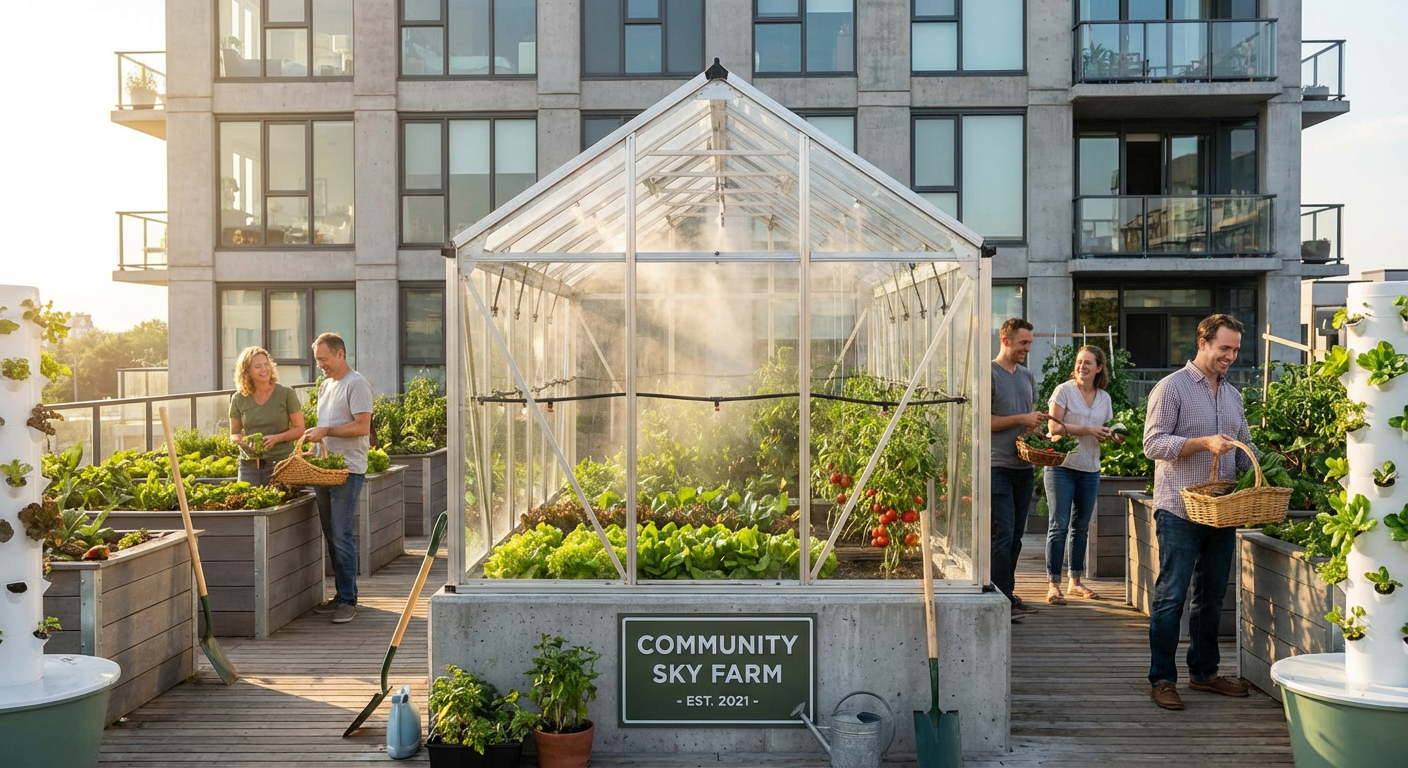
Advantages for Residential Projects
Why should your residential complex have hydroponic farming?
Property Value Increase
Green certification (LEED, BREEAM) points. Per-square-meter sale price increases 10-15%.
Fresh Food for Residents
Daily fresh vegetables from the rooftop greenhouse. Supply from your own building without going to the market.
Reduced Common Charges
Greenhouse revenue is transferred to the common expense fund. Maintenance fees can drop by 20%.
Social Living Space
Rooftop terrace green area + greenhouse. Stronger community relationships.
Eco-Friendly Image
Sustainable living. Carbon-neutral building. Marketing advantage.
Education and Hobby
Children learn farming. Seniors gain a hobby. Social activity.
1. Luxury Residence - Premium Concept
Example Project: 500-Unit Residence (Istanbul - Maslak)
Features:
- Building Type: A+ luxury residence (2+1, 3+1, 4+1)
- Units: 500 apartments (average 4 people/unit = 2,000 people)
- Roof Area: 800 m² hydroponic greenhouse
- Goal: Weekly fresh vegetable package for each apartment
System:
- Products: Gourmet lettuce, arugula, basil, microgreens
- Production: 600 kg per week (1.2 kg/week per apartment)
- Distribution: Concierge service (Monday morning at apartment door)
- Extra Revenue: Surplus sold to local restaurants
Financial:
- Investment: 60M TL (contractor + greenhouse company partnership)
- Operation: Building management (1 operator + 1 assistant)
- Revenue: 6M TL per year (vegetable value) – monthly fees reduced by 1,000 TL
- ROI: 10 years (fee savings + property value increase)
Marketing Advantage:
- “Fresh vegetables from your own greenhouse” slogan
- LEED Gold certification (greenhouse contributes +15 points)
- Sale price per m² increases by 12% (green building premium)
2. Mid-Range Residential Complex
Example Project: 300-Unit Housing Estate (Ankara - Yenimahalle)
Features:
- Building Type: Mid-range (2+1, 3+1)
- Units: 300 apartments (1,200 people)
- Roof Area: 500 m² hydroponic greenhouse
- Goal: Reduced common charges + social space
System:
- Products: Lettuce, tomatoes, cucumbers, fresh herbs
- Production: 400 kg per week
- Distribution: On-site mini market (30% discount for residents)
- Surplus: Open market sales (revenue to maintenance fund)
Financial:
- Investment: 38M TL (from maintenance fund + loan)
- Revenue: 3.6M TL per year (vegetable sales + mini market)
- Fee Impact: Monthly fees reduced by 600 TL
- ROI: 12 years
Social Benefits:
- Rooftop terrace picnic area + greenhouse (weekend events)
- Agriculture workshop for children (once a month)
- Hobby garden for retirees
3. Urban Renewal Project
Example Project: 1,000-Unit Urban Renewal (Izmir)
Features:
- Building Type: Social housing (2+1, 3+1)
- Units: 1,000 apartments (4,500 people)
- Roof Area: 1,200 m² hydroponic greenhouse
- Goal: Social benefit + food access
System:
- Products: Basic vegetables (lettuce, tomatoes, cucumbers, peppers)
- Production: 900 kg per week
- Distribution: Free basic package per apartment (200 g/week)
- Surplus: Sales to local businesses (grocery, greengrocer)
Financial:
- Investment: 90M TL (municipality + TOKI partnership)
- Revenue: 8M TL per year (external sales)
- Social Impact: Low-income families save 50 TL weekly on food
- ROI: Social project (not for profit)
Municipal Support:
- TOKI 50% grant (urban renewal incentive)
- Municipality operational support (first 3 years)
- Discounted electricity and water tariffs
4. Office + Residence Mixed Use
Example Project: Mixed-Use Complex (Istanbul - Atasehir)
Features:
- Building Type: Office (10 floors) + Residence (20 floors)
- Residence: 400 apartments
- Office: 150 companies (3,000 employees)
- Roof Area: 1,000 m² hydroponic greenhouse
System:
- Products: Premium vegetables + microgreens
- Distribution 1: Residents (weekly packages)
- Distribution 2: Office cafeterias (daily fresh salads)
- Extra: Ground floor organic market (open to public)
Financial:
- Investment: 75M TL (mixed investor)
- Revenue: 12M TL per year (residence + office + market)
- ROI: 7 years
- Added Value: Organic market tenant revenue (2M TL/year)
Marketing:
- “Pick up fresh vegetables when leaving the office”
- LEED Platinum certification
- Corporate social responsibility (CSR) project
5. Holiday Resort / Hotel
Example Project: 200 Villa Resort (Antalya - Belek)
Features:
- Building Type: Luxury villas + hotel
- Capacity: 200 villas + 500 hotel rooms
- Greenhouse Area: 600 m² (central location)
- Goal: Farm-to-table restaurant concept
System:
- Products: Exotic vegetables (shiso, mizuna, edible flowers)
- Distribution: Resort restaurants (5 restaurants)
- Experience: Guest greenhouse tours (agricultural tourism)
Financial:
- Investment: 45M TL (resort owner)
- Revenue: 5M TL per year (restaurant cost reduction)
- Marketing Value: “The vegetables on your plate were grown 50 meters away”
- ROI: 9 years
Additional Services:
- Children’s workshops (tomato picking experience)
- Farm dinner events (dinner inside the greenhouse)
- Organic product sales stand (guest shopping)
10-15%
With green certification m² value increase
600 kg
800 m² greenhouse weekly production
20%
With greenhouse revenue fee reduction
LEED
Gold/Platinum green certification
Option 1: Rooftop Greenhouse (Most Popular)
Features:
- Location: Building rooftop terrace
- Structure: Glass greenhouse or polycarbonate panels
- Area: 400-1,200 m² (depending on building size)
- Advantage: Natural sunlight – energy savings
- Extra Benefit: Roof insulation (cooler in summer, warmer in winter)
Technical:
- Structural reinforcement (greenhouse weight 150 kg/m²)
- Water and electrical connections to roof
- Direct elevator connection (logistics)
Option 2: Balcony/Terrace Modular Systems
Features:
- Location: Small module per apartment (1-2 m²)
- System: Mini hydroponic kit (plug & play)
- Products: Fresh herbs, microgreens
- Advantage: Each family produces their own
Package:
- Wall-mounted module (60x120 cm)
- Automatic irrigation (20-liter water tank)
- LED lighting (if daylight is insufficient)
- 3-month seed and nutrient kit
Cost: 5,000 TL/apartment (installation included)
Option 3: Underground Parking Vertical Farm
Features:
- Location: Unused parking area spaces (corners)
- System: LED-lit vertical farming
- Area: 100-200 m² (vertical 3 levels = 300-600 m² production)
- Advantage: Idle space utilized
Technical:
- Fully enclosed system (no sunlight)
- Full spectrum LED lighting
- Climate control (parking garage already enclosed)
- Electricity available, water line added
Cost: 12M TL (for 200 m²)
Option 4: Garden/Landscape Integration
Features:
- Location: Complex garden (ground level)
- System: Open/semi-open greenhouse
- Area: 500-1,500 m²
- Advantage: Part of the landscape (aesthetic)
Concept:
- Glass-visible greenhouse (architecturally harmonious design)
- Walking path + greenhouse tour (residents can visit)
- Seating areas + green walls
Green certification points earned with a hydroponic greenhouse:
LEED (US Standard)
Leadership in Energy and Environmental Design
- Sustainable Sites (+4 points): Green roof, heat island reduction
- Water Efficiency (+3 points): 95% water savings
- Energy & Atmosphere (+2 points): Solar panel integration
- Materials & Resources (+2 points): Local production, reduced transport
- Indoor Environmental Quality (+2 points): Fresh food access
- Innovation (+2 points): Hydroponic technology integration
- TOTAL: +15 points -- Easier transition to Gold level
BREEAM (UK Standard)
Building Research Establishment Environmental Assessment
- Land Use & Ecology (+3 points): Biodiversity, green space
- Water (+4 points): Water use efficiency
- Energy (+2 points): Low energy consumption
- Health & Wellbeing (+3 points): Fresh food, social space
- Innovation (+2 points): Innovative farming technology
- TOTAL: +14 points -- Very Good to Excellent
Additional Certifications
- CEDBIK (Turkey): Green Building Association certification
- EDGE (IFC World Bank): Green building certification for developing countries
- DGNB (Germany): Deutsche Gesellschaft fur Nachhaltiges Bauen
- Green Star (Australia): Sustainable building certification
Marketing Advantage: “LEED Gold Certified - Grow Your Own Vegetables” – Sale price increases 10-15%
Add a Hydroponic Greenhouse to Your Project
Is the roof structural calculation sufficient? Is reinforcement needed?
Structural Load Calculation:
- Hydroponic greenhouse total load: 150 kg/m² (structure + water + plants)
- Standard roof load capacity: 100-150 kg/m² (for snow load)
- Reinforcement: Usually needed (column support)
Solution:
1. Structural report (current capacity assessment) -- Technoponic arranges free of charge
2. If needed, lightweight construction greenhouse (aluminum frame)
3. Load distribution system (load transferred to columns)
Cost: Reinforcement ~15,000 TL/column (average 10 columns = 150,000 TL additional).
Will greenhouse odor/humidity damage the building?
No, it does not cause damage thanks to the closed system:
Odor:
- Hydroponics uses no soil -- no soil odor
- No organic fertilizer -- no fertilizer odor
- Only scent: Fresh plant aroma (basil, mint - pleasant scent)
Humidity:
- Greenhouse is a closed system (isolated from the building)
- Its own ventilation system (humidity is exhausted outside)
- No moisture transfer into the building
Extra Benefit: Greenhouse acts as roof insulation -- 15% energy savings in summer cooling and winter heating.
Who will operate it? Is building management sufficient?
3 Operating Models:
Model 1: Building Management (Recommended)
- Building hires 1-2 personnel (hydroponic operators)
- Technoponic provides 2-week training (certified)
- First year: Technoponic consulting (1 visit per month)
- Revenue: Transferred to maintenance fund
Model 2: PPP (Private Company Operates)
- Technoponic operates, shares profit (building 30% - company 70%)
- Building does not deal with anything, just receives revenue
Model 3: Cooperative (Residents Operate)
- Volunteer residents establish a greenhouse cooperative
- Hobby + income (ideal for retirees)
- Technoponic provides support
When should it be integrated into the project? Is post-construction possible?
Ideal: During the project phase (in design)
- Included in structural calculations (reinforcement cost decreases)
- Water/electrical infrastructure planned (no extra cost)
- Architectural integration (aesthetics, LEED certification)
- Financed within the construction loan
Alternative: Post-Construction (Retrofit)
- Possible but 20-30% more expensive
- Structural report + reinforcement may be needed
- Water/electrical lines added afterward
- Installation 3-4 weeks (noise may occur if building is occupied)
Latest: Add to the project at the end of rough construction (before finishing work).
How do residents get their vegetables? What is the distribution system?
Distribution Models:
1. Concierge/Doorman Service (Luxury Residence)
- Weekly package prepared (customized per apartment)
- Left at apartment door Monday morning
- Mobile app: "Remove from package: Green salad" notification
2. Mini Market/Stand (Mid-Range)
- Mini vegetable stand in entrance lobby
- Residents pick up anytime (QR code payment)
- Price: 30% below market
3. Order System (Digital)
- Mobile app: Place vegetable order
- Harvest: On order (ultra fresh)
- Delivery: Within 2 hours to apartment door
4. Self-Service Greenhouse (Experience)
- Residents go up to the greenhouse, harvest their own
- Scale + QR code payment
- Weekend family activity
How can it be used in sales marketing?
Marketing Slogans:
- "Fresh basil from your rooftop for breakfast"
- "LEED Gold Certified - Green Living"
- "1,000 TL monthly fee savings - With greenhouse revenue"
- "Let your children grow their own vegetables"
Sales Office Demonstration:
- Install a mini greenhouse in the sales office (live demo)
- Offer fresh lettuce to visitors
- VR glasses rooftop greenhouse tour
Brochure/Web:
- "Farm-to-table" concept highlighted
- Green certification logos (LEED, BREEAM)
- Greenhouse 3D visualization
Real Case: In Istanbul, a 500-unit residence doubled its sales speed after adding a greenhouse + m² price increased by 12%.
Does production continue during winter months?
Yes, 12 months uninterrupted production:
Winter Measures:
- Double-glazed greenhouse (insulation)
- Electric heating (greenhouse interior min 15C)
- Thermal curtain (prevents nighttime heat loss)
Energy Cost (Winter):
- 800 m² greenhouse: ~25,000 TL/month electricity (heating)
- Solution: Geothermal (if available) or building waste heat
- Solar panels: Winter sun 40% efficiency (summer 70%)
Production:
- Winter is ideal for leafy vegetables (lettuce, spinach, cress)
- Tomatoes/peppers in summer months
- Basil, mint 12 months
Extra Benefit: Greenhouse roof insulation -- Top-floor apartments save 20% on winter heating.
What happens in case of maintenance and breakdowns?
Maintenance Plan:
Daily (Operator):
- pH/EC check (5 minutes)
- Visual plant check (disease detection)
- Harvest (on order)
Weekly:
- Nutrient solution change
- Equipment cleaning
- Seed planting (continuity)
Monthly (Technoponic Technician):
- General system check
- Pump, valve maintenance
- Software update
Breakdown Scenario:
- Remote detection (automatic alert)
- Phone support (most issues resolved remotely)
- Emergency: Technician arrives within 24 hours
- Spare parts: Critical parts kept in building storage
Warranty: First 2 years all maintenance free. Afterwards annual maintenance contract (~50,000 TL/year).
Would you like to add a rooftop hydroponic greenhouse to your residential complex, luxury residence, or mixed-use project?
Feasibility Report Includes:
- Structural calculation and architect collaboration
- LEED/BREEAM certification contribution (point calculation)
- Fee impact and ROI analysis
- Distribution system recommendations
- Marketing material support (visualization)
- Reference project visit
Technoponic Headquarters Egitim Mahallesi Adim Sokak No:13-15B Kadikoy, Istanbul, Turkey
info@technoponic.com Instagram: @techno_ponic