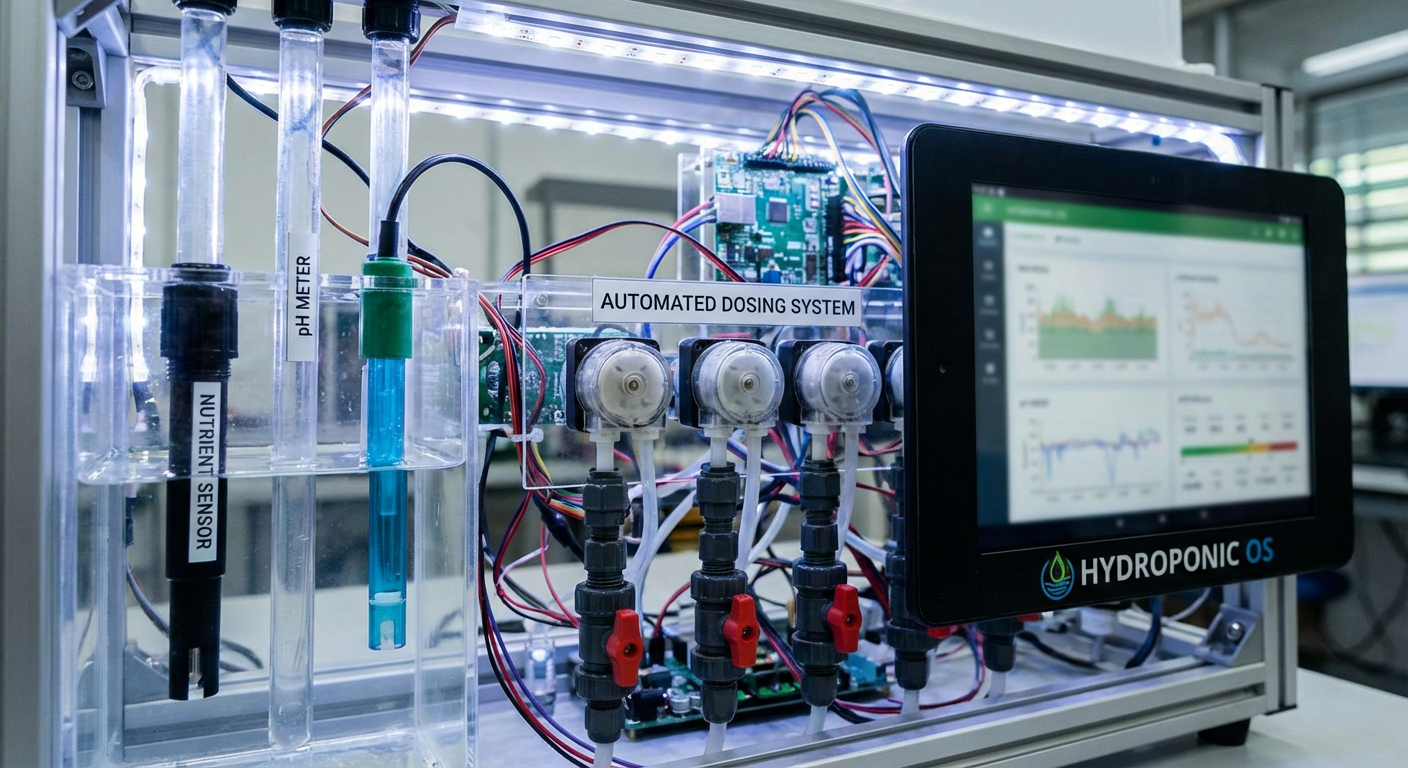
System Components
Core technical components of Technoponic KOBUS
Plant Growing System
NFT (Nutrient Film Technique) and DWC (Deep Water Culture) hybrid system. Design optimized per product.
Climate Control Unit
Temperature, humidity, CO2, ventilation automation. 35% energy savings with AI-assisted algorithm.
Irrigation and Nutrition
Closed-loop irrigation system. Product-specific nutrient recipes with automatic dosing.
Lighting System
Sunlight + LED hybrid. 20% faster growth with spectrum optimization.
Automation and Monitoring
PLC-based control system. 24/7 monitoring and remote intervention via mobile app.
Energy Management
Solar panel integration. 60% energy cost reduction with smart grid connection.
1. NFT (Nutrient Film Technique)
Application: Leafy vegetables (lettuce, arugula, cress), fresh herbs (mint, parsley)
Working Principle:
- Plants grow on a thin nutrient film in special channels
- Continuously circulating nutrient solution makes minimal contact with roots
- Roots receive both nutrients and oxygen (optimal growth)
Advantages:
- 95% water savings (closed loop)
- Fast growth (24-day harvest)
- High yield (16 harvests/year)
- Low maintenance requirement
2. DWC (Deep Water Culture)
Application: Basil, aromatic plants, tomatoes, peppers
Working Principle:
- Plants submerge their roots in oxygen-enriched nutrient solution
- Continuous oxygenation with air stones
- 100% nutrient access for roots
Advantages:
- Strong root development – healthier plants
- High yield (1 kg/m²/harvest for basil)
- Ideal for long-lived plants
- Easy nutrient monitoring
3. Aeroponics (Advanced - Optional)
Application: Premium products (medicinal plants, microgreens)
Working Principle:
- Roots are suspended in air
- Nutrient solution sprayed onto roots via ultra-fine mist
- Maximum oxygen + nutrient access
Advantages:
- Fastest growth (30% faster)
- Maximum yield
- Requires high technical knowledge
- Higher investment cost
Note: Technoponic primarily recommends NFT and DWC systems (proven, easy to operate). Aeroponics is optional for experienced growers.
Controlled Parameters
| Parameter | Target Range | Tolerance | Automation |
|---|---|---|---|
| Temperature | 18-24C (product dependent) | +/-1C | Heating/Cooling automatic |
| Humidity | 60-75% | +/-5% | Humidification/Dehumidification |
| CO2 | 800-1200 ppm | +/-100 ppm | CO2 injection |
| Ventilation | 15-20 exchanges/hour | - | Fans automatic |
| Light Intensity | 200-400 umol/m²/s | +/-20 | LED dimmer control |
Climate Control Components
Temperature Management
- Heating: Electric resistance (backup: geothermal optional)
- Cooling: Evaporative cooler (low energy)
- Insulation: Sandwich panel (U=0.25 W/m²K)
- Sensor: PT100 precision temperature sensor (+/-0.1C)
Humidity Control
- Humidification: Ultrasonic humidifier (ultra-fine mist)
- Dehumidification: Dehumidifier (condensation type)
- Natural Ventilation: Automatic windows (energy savings)
- Sensor: Capacitive humidity sensor (+/-2% precision)
CO2 Enrichment
- Source: Liquid CO2 cylinder or generator
- Dosing: Electromagnetic valve (precision control)
- Yield Increase: 20-30% faster photosynthesis
- Sensor: NDIR CO2 sensor (+/-50 ppm precision)
Lighting
- Primary: Natural sunlight (zero cost)
- Supplemental: Full spectrum LED (red + blue + white)
- Automation: Automatic on/off via light sensor
- Energy: Solar panel + grid (hybrid)
Nutrient Elements
Macro Elements (High Concentration):
- Nitrogen (N): Leaf development, green color
- Phosphorus (P): Root development, flowering
- Potassium (K): Fruit quality, disease resistance
- Calcium (Ca): Cell wall strength
- Magnesium (Mg): Chlorophyll production
- Sulfur (S): Protein synthesis
Micro Elements (Low Concentration):
- Iron (Fe), Manganese (Mn), Zinc (Zn), Copper (Cu), Boron (B), Molybdenum (Mo)
Nutrient Solution Parameters
| Parameter | Target Value | Measurement Frequency | Adjustment |
|---|---|---|---|
| pH | 5.5 - 6.5 | Every 4 hours (automatic) | Acid/Base dosing pump |
| EC (Conductivity) | 1.5 - 2.5 mS/cm | Every 4 hours (automatic) | Nutrient/Water dosing |
| Temperature | 18-22C | Continuous | Heater/Cooler |
| Dissolved Oxygen | >5 mg/L | Daily (manual) | Air stone, pump |
Automatic Dosing System
Technoponic Proprietary Recipe System (Patented)
- Optimized recipes for 105+ products: Each plant receives its own special nutrient formula
- Automatic changes by growth stage: Different recipes for seedling, growth, pre-harvest stages
- AI learning: System optimizes itself after each harvest
- Remote updates: New recipes automatically downloaded from central system
Confidentiality Note: Detailed formulas of nutrient recipes are trade secrets and are only shared with contracted customers.
PLC-Based Automation
Control Unit:
- Brand: Siemens / Schneider (industrial grade)
- I/O: 64+ channels (expandable)
- Communication: Ethernet, Modbus, MQTT (IoT)
- Backup: RAID system, cloud synchronization
Sensor Network
| Sensor Type | Quantity (for 1,656 m²) | Measurement | Precision |
|---|---|---|---|
| Temperature | 8 zones | Air temperature | +/-0.1C |
| Humidity | 8 zones | Relative humidity | +/-2% |
| CO2 | 4 points | ppm | +/-50 ppm |
| pH | 2 tanks | Acidity | +/-0.05 |
| EC | 2 tanks | Conductivity | +/-0.01 mS/cm |
| Light | 4 points | PAR (umol) | +/-5% |
| Water Level | 2 tanks | Volume | +/-1% |
| Flow | 2 lines | L/minute | +/-2% |
Mobile Application (iOS + Android)
Real-Time Monitoring:
- All sensor data as live graphs
- Visual tracking via IP camera
- Instant abnormal condition notification (SMS + Push)
- Historical data analysis and reporting
Remote Control:
- Temperature/Humidity target value adjustment
- Lighting on/off
- Manual irrigation start
- System parameter changes
Smart Recommendations (AI):
- Optimization suggestions (“If CO2 is raised to 900 ppm, 8% faster growth”)
- Early warnings (“Disease risk within 48 hours - take precautions”)
- Automatic harvest calendar updates
24 Days
Average harvest time for lettuce
16 Harvests
Annual production cycles
95 kg/m²
Annual area efficiency
95%
Compared to open field water savings
Energy Consumption Distribution (1,656 m² Facility)
| System | Power (kW) | Annual Consumption (kWh) | Cost (TL/year)* | Share |
|---|---|---|---|---|
| Climate Control | 45 | 180,000 | 540,000 | 45% |
| Lighting (LED) | 30 | 105,000 | 315,000 | 26% |
| Irrigation Pumps | 15 | 60,000 | 180,000 | 15% |
| Automation/Monitoring | 8 | 35,000 | 105,000 | 9% |
| Other (packaging etc.) | 12 | 20,000 | 60,000 | 5% |
| TOTAL | 110 kW | 400,000 kWh | 1,200,000 TL | 100% |
*3.00 TL/kWh industrial tariff assumption
Solar Energy Integration
Rooftop Solar Panel System:
- Capacity: 150 kWp (for 1,656 m²)
- Panel Count: 300 units x 500W
- Annual Production: ~240,000 kWh (for Istanbul)
- Coverage Ratio: 60% (daytime consumption)
- Payback: 4 years (3 years with incentives)
Smart Grid Connection:
- Daytime: Use solar energy, sell surplus to grid
- Nighttime: Draw from grid (low tariff)
- Battery (Optional): 50 kWh Tesla Powerwall – 80% coverage
Energy Savings Measures
Climate Optimization
- - Nighttime temperature reduction (-2C = 15% energy savings)
- - Humidity cascade control (natural ventilation first)
- - CO2 daytime injection only (off at night)
Lighting Savings
- - Maximum sunlight utilization (LED as supplement)
- - Automatic dimming via light sensor
- - Spectrum adjustment by growth stage
Required Infrastructure (for 1,656 m² Facility)
1. Electrical Infrastructure
- Power Requirement: 110 kW (150 kVA transformer recommended)
- Phase: 3 phase 400V + neutral + ground
- Backup: 125 kVA diesel generator (for critical systems)
- Panel: Main distribution panel + sub-panels (10 units)
2. Water Infrastructure
- Water Inlet: Municipal or well (min 10 m3/day)
- Water Quality: TDS <200 ppm (reverse osmosis may be needed)
- Storage: 20 m3 underground tank + 5 m3 daily tank
- Wastewater: Minimal (only cleaning water - sewage sufficient)
3. Building Requirements
- Area: 1,656 m² enclosed space (minimum 5 meter height)
- Structure: Sandwich panel or prefabricated (quick assembly)
- Insulation: U-value max 0.25 W/m²K (energy savings)
- Floor: Concrete (waterproofed, drainage system)
- Light Transmission: Roof transparent or translucent panel (40% sunlight)
4. Climate Equipment
- Heating: Electric resistance + geothermal (optional)
- Cooling: Evaporative cooler (cooling pad system)
- Ventilation: Axial fans (6 units) + air inlet damper
- Humidification/Dehumidification: Ultrasonic + dehumidifier
5. Additional Spaces
- Seedling Production Room: 100 m² (separate climate control)
- Harvest/Packaging: 150 m² (cold room included)
- Storage/Technical: 100 m² (spare parts, equipment)
- Office/Staff: 50 m² (meeting, rest, changing)
Installation Timeline and Phases
| Phase | Duration | Description |
|---|---|---|
| 1. Feasibility/Project | 2 weeks | Technical drawings, engineering |
| 2. Building Construction | 6 weeks | Prefabricated assembly or construction |
| 3. Equipment Installation | 4 weeks | Hydroponic system, automation |
| 4. Testing and Calibration | 1 week | All systems startup |
| 5. Training | 1 week | Staff training (theory + practice) |
| 6. First Planting | - | Production start |
| TOTAL | ~14 weeks | Approximately 3.5 months |
Technical Details and Feasibility
How durable are the systems? What is the lifespan?
Lifespan by component:
- Structure (sandwich panel): 30+ years
- Hydroponic channels: 20+ years (UV-resistant plastic)
- Pumps/Motors: 10-15 years (with regular maintenance)
- LED lighting: 50,000 hours (5-7 years continuous)
- PLC/Automation: 15+ years (software updatable)
- Sensors: 5-10 years (with calibration)
Average system lifespan: 20 years (30+ years possible with regular maintenance).
What if water quality is poor (high TDS, excess hardness)?
Water Treatment Systems:
- TDS >200 ppm: Reverse Osmosis (RO) system required
- High hardness: Water softener (ion exchanger)
- Chlorine/Chloramine: Activated carbon filter
- High iron/manganese: Special filter (oxidizer)
Cost: RO system for 1,656 m² ~150,000 TL (one-time). Annual maintenance ~25,000 TL.
Note: Water analysis is performed during the feasibility phase, and necessary systems are added to the project.
How long can it last during a power outage?
Outage Scenarios:
- Summer (hot): Climate control critical -- lasts 2-4 hours (then overheating)
- Winter (cold): Heating critical -- lasts 4-6 hours (then low temperature)
- Irrigation pump: Lasts 8-12 hours (roots remain moist)
Solutions:
- UPS (5-10 minutes): For momentary outages, until generator activates
- Diesel Generator: Activates within 30 seconds, runs indefinitely
- Battery System (Tesla Powerwall): 4-6 hour backup (quiet)
Recommendation: UPS + Generator combination (seamless transition).
Is a single operator enough or is a team needed?
Recommended staff for 1,656 m² facility:
- Facility Manager (1 person): General management, sales, finance
- Production Supervisor (1 person): Daily operations, nutrient control, disease monitoring
- Harvest/Packaging (2 people): Harvesting, packaging, shipment preparation
- Technical Maintenance (part-time): Monthly check (Technoponic support center)
Total: 3-4 people (shift work optional).
Thanks to automation: System manages itself; staff focus only on harvest and packaging.
What happens if disease or pests are detected?
Closed system = minimal risk but precautions are still in place:
Early Detection:
- Daily visual leaf inspection
- AI camera system (color change, spot detection)
- Automatic alert: "Fungal risk within 48 hours - take precautions"
Organic Intervention (No Chemicals):
- Fungus/Mold: Copper sulfate (organic), biological fungicide
- Pests (rare): Insect traps, neem oil spray
- Root rot: Hydrogen peroxide (H2O2) in nutrient solution
- Quarantine: Infected section isolated, early harvest performed
Prevention Protocol:
- Entry hygiene (shoe disinfection, gloves)
- Air filtration (HEPA filter)
- Equipment sterilization (UV-C light)
How often is the nutrient solution changed? What is the cost?
Nutrient Change Period:
- NFT System: Full change every 2 weeks (as plants absorb nutrients, water evaporates -- concentration shifts)
- DWC System: Every 3 weeks (larger volume, more stable)
- Daily Check: pH and EC measurement, add missing nutrients
Nutrient Cost (1,656 m² - Annual):
- Macro elements (NPK + Ca + Mg + S): ~180,000 TL/year
- Micro elements (Fe, Mn, Zn etc.): ~60,000 TL/year
- pH adjustment chemicals (acid/base): ~30,000 TL/year
- Total: ~270,000 TL/year (for 157 tons lettuce production)
Unit cost: ~1.72 TL/kg lettuce (nutrient expense).
Am I independent from Technoponic after system installation?
Partially independent, but recommended support:
Areas You Can Be Independent:
- Daily production operations (after training)
- Routine maintenance (simple part replacement)
- Nutrient preparation (recipes loaded in system)
- Harvesting and packaging
Technoponic Support Recommended:
- Adding new products: New recipe development (basil to tomato transition)
- Software updates: 2-3 times/year (automatic)
- Performance optimization: 10-15% yield improvement
- Critical breakdown: Expert intervention (usually resolved remotely)
Support Packages:
- Basic (free 1 year): 24/7 phone support, remote access
- Premium (50,000 TL/year): Monthly visit, priority spare parts, new recipes
Does the system work if the internet connection is lost?
Yes, the system operates locally.
Without Internet Connection:
- All automation works (PLC makes local decisions)
- Temperature, humidity, CO2, irrigation control continues
- Sensor recordings accumulate in local memory
- Remote monitoring unavailable (mobile app won't work)
- Cannot download new recipes from central system
- Automatic alerts won't come (SMS/email)
When Internet Returns:
- All accumulated data automatically synchronized
- Missed alerts reported
- Remote access activated
Recommendation: Backup internet line (4G modem) recommended for critical facilities (cost ~500 TL/month).
Would you like a detailed technical report for your own project and to meet with our engineers?
Technical Feasibility Report Includes:
- Equipment list (brand, model, quantities)
- Electrical, water, building infrastructure requirements
- Energy consumption calculation (monthly, annual)
- Nutrient and chemical material requirements
- Personnel needs and training plan
- Installation timeline (Gantt chart)
- Maintenance and spare parts plan
Technoponic Headquarters Egitim Mahallesi Adim Sokak No:13-15B Kadikoy, Istanbul, Turkey
info@technoponic.com Instagram: @techno_ponic